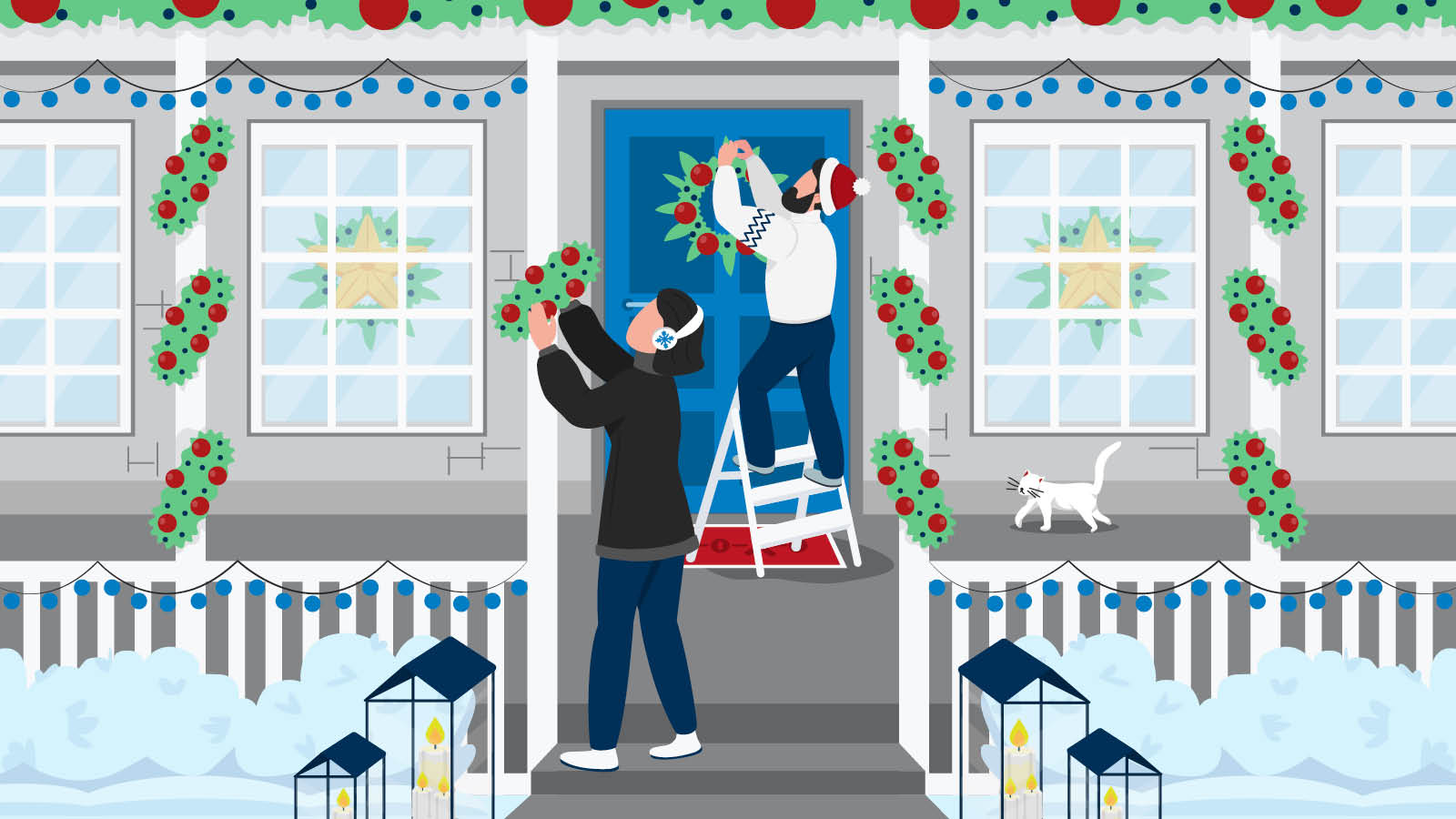
From Grandma’s dinnerware sets to your child’s homemade ornaments, lots of holiday treasures have a glittering history unique to each family. And while you may remember the year you knitted those stockings or all the times you lit that childhood menorah, many other classic items tucked away in storage also have long, storied pasts you might not even know about.
This year, lean into the holiday spirit by exploring some history. Because, from mistletoe to poinsettias, these 10 home décor staples are historical symbols of light and bright holidays past.
Candy canes actually date all the way back to 1670. The story goes that a German choirmaster gave sugar sticks to his fidgety young singers to try and keep them quiet during religious ceremonies. This is also why they were bent into their signature shape — a shepherd’s crook — to tie right back into the religion.
Now, every December, you’ll find candy canes everywhere, from trees, to wreaths, to tablescapes, and more. And, whether you buy a pack or make your own, no doubt they make a tasty addition to any holiday celebration.
After the invention of the lightbulb, Edward Johnson, one of Thomas Edison’s engineers, had the bright idea to replace the candles that were common on Christmas trees with these cutting-edge contraptions. He decorated his own Christmas tree with 80 colorful lights, placed it on a rotating platform, and set it in his front window. And passersby certainly felt the spirit! So, the next year, Johnson took to the outdoors. He covered a 45-foot tree with more than 200 bulbs.
Soon after, light bulbs became significantly more affordable, and the rest is, well, history.
The menorah is one of the oldest symbols in Jewish tradition. According to the Hebrew Bible, a seven-branched golden lampstand was given to Moses for use in the Tabernacle and later became a central fixture in the ancient Temple in Jerusalem.
Centuries later, during the Maccabean Revolt, the Temple was reclaimed and rededicated. Rabbinic tradition teaches that when the Jews went to relight the Temple’s lampstand, they found only enough oil for one day. But miraculously, it burned for eight.
Today’s Hanukkah menorah, which has nine branches instead of seven, commemorates that event and remains an important symbol for Jewish families around the world.
The holly plant has historical significance spanning global cultures and religions.
Ancient Romans and Celts utilized it for winter solstice celebrations, while the sharp leaves and berries came to symbolize Christ’s crown and blood to the Christians. Holly can also be found in various ancient folklore, from Scotland to Spain to the Indigenous North Americas.
Wreaths were popularized as headwear in Ancient Rome and Greece, but as Christianity spread across Europe it was incorporated into Christmas traditions and iconography.
The ring shape is said to symbolize eternal life and serves as a visual symbol of the Christmas spirit.
Today, wreaths are one of the easiest and most enjoyable DIY projects out there, with modern takes made up of everything from ornaments to dried florals.
The kinara, a seven-branched candelabra, is an important focal point in any Kwanzaa celebration . This particular piece of decor dates back to 1966, when Dr. Maulana Karenga first created the week-long holiday.
Dr. Karenga assigned each of the seven days a principle, which is discussed as the corresponding candle is lit each evening. These include unity, self-determination, collective work and responsibility, cooperative economics, purpose, creativity, and faith.
This classic holiday plant’s romantic connotation goes back to antiquity, as it was historically used for fertility and as an aphrodisiac.
One of the earliest known references to kissing under the mistletoe is found in the 1784 opera Two to One. Whether hanging the real thing or a faux version, mistletoe is sure to add a sweet and storied sentiment to your holiday décor.
The poinsettia is native to Mexico, flowers in the winter, and, as it resembled the Star of Bethlehem to Spanish missionaries, its name translates to “flower of the holy night”.
According to a Mexican Christmas story, a poor young girl named Pepita did not have a gift for the baby Jesus. On Christmas Eve, she offered up a bouquet of weeds, which the angels compassionately transformed into brilliant red and green blossoms.
The colors became synonymous with Christmas, an influence we can still clearly see today.
Believe it or not, Clement Clarke Moore’s “‘Twas the Night Before Christmas” inspired hanging your stocking with care.
Since the poem’s publication in the early 1800s, placing a sock on the mantel has become a Christmas custom.
This holiday favorite dates back to ancient Egypt – where Egyptians would fill their homes with green palms and papyrus reeds at the solstice to celebrate the sun god Ra recovering from illness – and Rome – where residents hung evergreen boughs over their doors in honor of Saturn and the coming spring.
The Christmas tree as we know it, however, is only a few centuries old. In some Lutheran traditions it’s believed that, in 16th century Germany, Protestant reformer Martin Luther was so inspired by a scene of stars amid evergreen branches that he brought a tree into his home and covered it with candles. The practice took off across Europe and eventually may have come to America via the German settlers of Pennsylvania.
Pulling out the holiday décor each year can feel like a festive trip down memory lane!
From cherished family heirlooms to unique customs and traditions, understanding and reflecting on the old and the new is a great way to tie up the current year and prepare for the next.
Whatever your holiday home décor might be, soak in the nostalgia of the season and, come the new year, break out the bubble wrap and pack those cherished memories back up safely.
After all, you’ve almost certainly got a little piece of history on your hands!